Covering Trauma: Impact on Journalists
An overview of current research on the occupational hazards for journalists covering traumatic events, the risk factors that aggravate those effects, and some suggestions for mitigating those factors. Originally published by River Smith and Elana Newman in January, 2009; Updated by Susan Drevo in May, 2016, and by Autumn Slaughter in March, 2019.
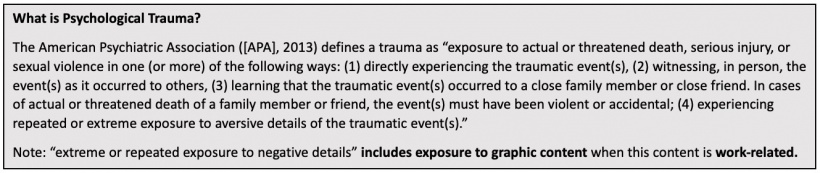
Journalists frequently bear witness to human suffering, whether covering mass disasters or individual atrocities, and are sometimes the direct targets of violence. This type of work can affect their health and well-being. This fact sheet reviews existing research regarding:
- The types of events journalists are exposed to;
- The impact of covering these events;
- The factors that may place journalists at risk for post-traumatic stress disorder (PTSD)
TRAUMA EXPOSURE
The majority of journalists witness traumatic events in their line of work:
- Research suggests that between 80 and 100% of journalists have been exposed to a work-related traumatic event (e.g., Dworznik, 2011; Feinstein et al, 2002; Newman et al., 2003; Pyevich et al., 2003; Smith et al., 2017; Teegen & Gotwinkel, 2001).
- Many experience repeated exposure.
- 92% of journalists reported experiencing at least four traumatic situations (Weidman et al., 2008).
- Studies suggest the average number of work related traumatic events ranges from 4 to 81, depending on the population being studied (Newman et al., 2003; Pyevich et al., 2003; Teegen et al., 2001; Weidmann et al., 2008).
Journalists may witness traumatic events:
- Common events may include (Dworznik, 2011; Feinstein et al., 2014; Feinstein et al, 2002; Newman et al., 2003; Pyevich et al., 2003; Simpson & Boggs, 1998; Smith et al., 2017; Teegen & Gotwinkel, 2001):
- Automobile accidents
- Fires
- Executions
- Murders
- Mass casualties
- Wars
- Disasters
- Exposure to user generated content
- Work-related traumatic content may be experienced via frequent, repeated, and prolonged exposure to violent graphics and/or video footage, including user generated content (Feinstein et al., 2014; Weidmann & Papsdorf, 2010).
- Some journalists may witness events involving death, violence and human suffering. These can be particularly disturbing, especially when the events involve children (Newman et al., 2003; Pyevich et al., 2003; Smith et al., 2017).
Journalists may also directly experience traumatic events:
- Journalists experience violence, intimidation (verbal or physical threats focused on a person’s work as a journalist) and harassment (aggressive verbal or physical actions directed at someone because of another personal characteristic)
(Drevo, 2016; Feinstein, 2012; Feinstein et al., 2016; Monterio et al., 2015; Morales et al, 2012).- In 2018, 348 journalists were detained worldwide. Some of these detainees faced physical torture, extreme isolation, and other mistreatment (Reporters Without Borders [RSF], 2018).
- In one study of 977 female journalists, 21.9% reported experiencing physical violence in relation to their work, and 14.3% reported experiencing sexual violence in relation to their work (Barton & Storm, 2016).
- 31% of Swedish journalists report receiving threats over the course of a year (Löfgren Nilsson & Örnebring, 2016).
HOW JOURNALISTS ARE AFFECTED
Despite repeated exposure to work-related traumatic events, most journalists exhibit resilience. This is evidenced by relatively low rates of post-traumatic stress disorder (PTSD) and other psychiatric disorders, despite high trauma exposure.
A significant minority, however, are at risk for long-term psychological problems, including PTSD (Drevo, 2016; Feinstein & Owen, 2012; Morales et al., 2014).
More notably, journalists may experience a strong reaction or set of reactions to covering harrowing events such as war, disasters and other human suffering. This is not necessarily a problem, but simply a signal of the emotional challenges of news gathering, and a signal to practice self-care.
This fact sheet focuses on high sustained levels of distress that interfere with functioning.
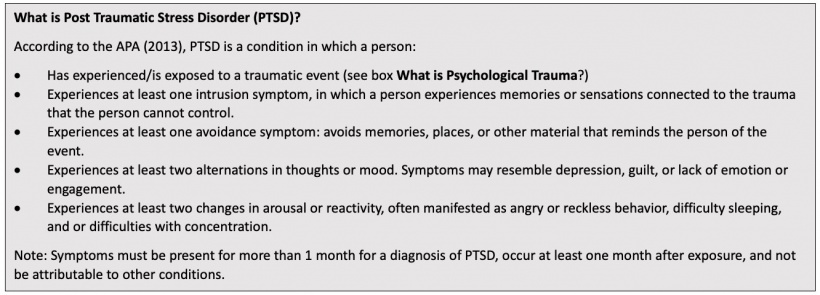
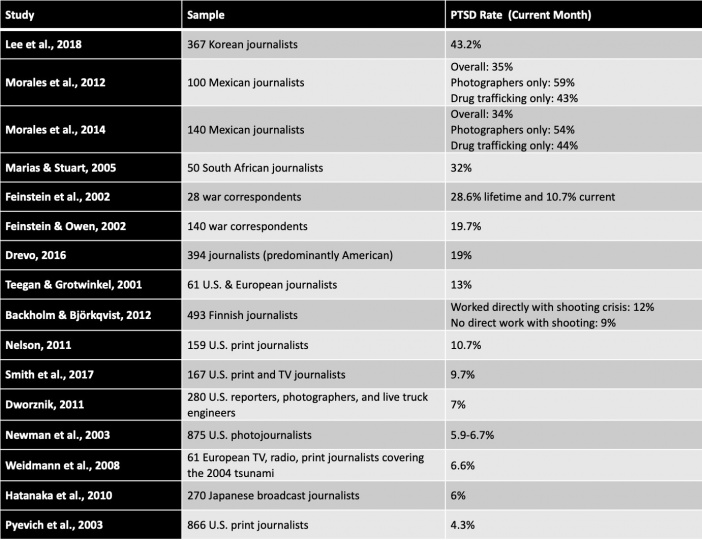
Journalists’ post-traumatic stress disorder (PTSD) rates range from 4 to 59% depending on the beats covered, and location of the journalists studied (detailed rates below):
RATES OF PTSD (ORDERED FROM HIGHEST TO LOWEST)
RISK FACTORS for ptsd
- Personally experienced work-related stressors
- Exposure to a greater number of traumatic assignments/frequency of exposure (Marais & Stuart, 2005; McMahon, 2001; Newman et al., 2003; Pyevich et al., 2003)
- Exposure to a greater amount of user generated content (Feinstein et al., 2014)
- Exposure to high intensity assignments/type of traumatic assignment (Backholm & Bjӧrkqvist, 2010; Dworznik, 2011; Feinstein et al., 2002; Pyevich et al., 2003; Smith et al, 2017)
- Covering the drug trade (Feinstein, 2013; Morales et al., 2012, 2014).
- Exposure to war (Dworznik, 2011; Feinstein et al., 2002; Simpson & Boggs, 1999)
- Journalists embedded with troops do not appear to be at greater risk than unilateral journalists covering the war (Feinstein & Nicholson, 2005; Greenberg et al., 2007).
- Exposure to ethnic violence (Feinsten et al., 2015)
- Working in the field (as opposed to non-field job; Hatanaka et al., 2010)
- Personally experienced work-related stressors
- Aggression (Occupational intimidation and sexual harassment) (Drevo, 2016)
- Intimidation (Feinstein, 2012)
- Moral injury (Drevo, 2016)
- Time in the field
- Novice journalists (Teegen & Wrotwinkel, 2001)
- Journalists with more experience, after controlling for life stressors experienced in the past six months (Simpson & Boggs, 1999)
- These journalists had more experience covering stories in the field, and may have had more overall trauma exposure.
- Organizational Factors
- High levels of perceived organizational stress (Smith et al., 2017)
- Inconsistent leadership styles, conflicts with supervisors, and changes to organizational policy (Smith et al., 2017)
- Sexual harassment in the workplace (Parker, 2015)
- Working with user-generated content (Feinstein et al., 2014)
- Personal History and Characteristics
- Threats to one’s sense of professional ethics or moral compass (Moteiro et al., 2015; Drevo, 2016)
- Exposure to traumatic events in one’s personal life (Backholm & Bjӧrkqvist, 2010; Newman et al., 2003; Smith et al., 2017; Teegen & Wrotwinkel, 2001)
- Prior history of psychological problems (e.g., depression; Backholm & Bjӧrkqvist, 2012)
- Empathy, with higher levels of empathy predicting more symptoms (Nelson, 2011)
- Temperament (e.g., a tendency to be hostile, anxious, fearful, or frustrated; Marais & Stuart, 2005)
- Difficulty with emotional expression (Teegen & Grotwinkel, 2001)
- Avoidant styles of coping (Smith et al., 2017)
- Peri-traumatic response (Hatanaka et al., 2010; McMahon, 2001)
- More stress symptoms at the time of the trauma predict the presence of PTSD symptoms.
- Social Support
- Low perceived social support (Newman et al., 2003)
- Competition with colleagues (Monterio et al., 2015)
- Cognitive Factors
- Negative beliefs about self, others and the world following a traumatic event (Pyevich et al., 2003)
- Feelings of guilt about the traumatic event (Browne et al., 2012)
Note: Gender has not been found as a risk factor for PTSD among journalists (Feinstein & Sinyor, 2012; Sinyor & Feinstein, 2012). This differs from the general population, with women at higher risk for PTSD (e.g., Kessler et al, 1994; Lilly, et al., 2009), possibly because women are at high risk of experiencing interpersonal trauma (APA, 2013).
PROTECTIVE FACTORS for PTSD
- Ability to control emotional reactions (Nelson, 2011)
- Ability to endure difficult situations (Smith et al., 2017)
- Manageability (e.g., ability to cope with challenges and access to resources needed to overcome challenges; Marias & Stuart, 2005)
- A strong sense of meaning and purpose as a journalist (Novak & Davidson, 2013)
- Training that facilitated social networks and meaningful coping mechanisms (Novak & Davidson, 2013)
- Management support (Beam & Spratt, 2009)
- Perceived organizational support (Drevo, 2016)
PTsd occupational impact
- Very few studies examine the impact of trauma exposure and PTSD symptoms on a journalist’s occupational success. Initial dissertation results suggest PTSD symptoms may result in impaired occupational functioning, interfering with journalists' optimal work performance.
- PTSD symptom severity predicted greater perceived occupational dysfunction in (Drevo, 2016; Nelson, 2011):
- Tardiness
- Missed deadlines
- Difficulty concentrating at work
- PTSD symptom severity predicted greater perceived occupational dysfunction in (Drevo, 2016; Nelson, 2011):
- Other predictors of poorer occupational functioning:
- Younger age (Drevo, 2016)
- Moral injury (e.g. threats to one’s sense of professional ethics or moral compass) (Drevo, 2016)
- Occupational intimidation (Parker, 2015)
- Sexual harassment was related to decreased perceived organizational support and increased behaviors that might harm an organization or its employees (Parker, 2015)
CONCLUSIONS
Taken together, these studies suggest journalists are at risk for exposure to work-related traumatic events. Further, some journalists exposed to these events appear vulnerable to the development of PTSD and other psychiatric symptoms. This is particularly true of war correspondents and Mexican journalists covering the drug trade, perhaps due to direct threats made against them. To date, not all risk factors for PTSD have been examined in journalists and even fewer studies have examined multiple risk factors simultaneously.
Based on the existing research, efforts to increase organizational support for journalists may be warranted. More organizational support may result in a reduction of mental health harm, as well as a reduction in occupational dysfunction and an increase in job performance (and likely work satisfaction). Aiding connectedness to social networks within and outside of an organization may also be of benefit.
Further, considering most journalists will cover a trauma-related event or be the targets of personal attacks involving intimidation and harassment, training and education about risks and adaptive coping methods may be beneficial, though such benefits are not currently reflected in the literature.
REFERENCES
American Psychiatric Association. (2013). Diagnostic and statistical manual of mental disorders (5th ed.). Arlington, VA: American Psychiatric Association.
Backholm, K., & Björkqvist, K. (2010). The effects of exposure to crisis on well-being of journalists. A study on crisis-related factors predicting psychological health in a sample of Finnish journalists. Media, War & Conflict, 3, 138-151.
Backholm, K., & Björkqvist, K. (2012). The mediating effect of depression between exposure to potentially traumatic events and PTSD in news journalists. European Journal of Psychotraumatology, 3, 183-88.
Barton, A., & Storm, H. (2016). Violence and harassment against women in the news media: A global picture. Women’s Media Foundation and the International News Safety Institute.
Beam, R. A., & Spratt, M. (2009). Managing vulnerability: job satisfaction, morale and journalists’ reactions to violence and trauma. Journalism Practice, 3, 421-438.
Brown, T., Evangeli, M., & Greenberg, N. (2012). Trauma-related guilt and posttraumatic stress among journalists. Journal of Traumatic Stress, 25, 207-210.
Drevo, S. (2016). The war on journalists: Pathways to posttraumatic stress and occupational dysfunction among journalists. Unpublished doctoral dissertation, University of Tulsa, Oklahoma.
Dworznik, G. (2011). Factors contributing to PTSD and compassion fatigue in television news workers. International Journal of Business, Humanities, and Technology, 1(1), 22-32.
Feinstein, A., Wanga, J., & Owen, J. (2015). The psychological effects of reporting extreme violence: a study on Kenyan journalists. Journal of the Royal Society of Medicine, 6, 1 – 6.
Feinstein, A. (2013). Mexican journalists and journalists covering war: a comparison of psychological wellbeing. Journal of Aggression, Conflict, and Peace Research, 5, 77-85.
Feinstein, A. (2012). Mexican journalists: An investigation of their emotional health. Journal of Traumatic Stress, 25, 480-483.
Feinstein, A., Audet, B., & Waknine, E. (2014). Witnessing images of extreme violence: a psychological study of journalists in the newsroom. Journal of the Royal Society of Medicine Open, 5, 1-7.
Feinstein, A., Feinstein, S., Behari, M., & Pavisian, B. (2016). The psychological wellbeing of Iranian journalists: A descriptive study. Journal of the Royal Society of Medicine Open, 7(12), 1 – 5.
Feinstein, A. & Nicholson, D. (2005). Embedded journalists in the Iraq war: Are they at greater psychological risk? Journal of Traumatic Stress, 18, 129-132.
Feinstein, A. & Owen, J. (2002). Journalists, war and posttraumatic stress disorder. In Y. Danieli (Ed.), Sharing the front line and the back hills: International protectors and providers: Peacekeepers, humanitarian aid workers and the media in the midst of crisis (pp. 305-315). Amityville, NY: Baywood Publishing Co, Inc.
Feinstein, A., Owen, J., & Blair, N. (2002). A hazardous profession: War, journalism, and psychopathology. American Journal of Psychiatry, 159, 1570-1576.
Feinstein, A., & Sinyor, M. (Winter, 2009). Women war correspondents: They are different in so many ways. Nieman Reports, 24 – 25.
Greenberg, N., Thomas, S., Murphy, D., & Dandeker, C. (2007). Occupational stress and job satisfaction in media personnel assigned to the Iraq War: A qualitative study. Journalism Practice, 1(3), 356-371.
Hatanaka, M., Matsui, Y., Ando, K., Inoue, K., Fukuoka, Y., Koshiro, E., & Itamura, H. (2010). Traumatic stress in Japanese broadcast journalists. Journal of Traumatic Stress, 23, 173-177.
Kessler, R. C., Berglund, P., Demler, O., Jin, R., Merikangas, K. R., & Walters, E. E. (2005). Lifetime prevalence and age-of-onset distributions of DSM-IV disorders in the National Comorbidity Survey Replication. Arch Gen Psychiatry, 62, 593–602.
Kessler, R. C., McGonagle, K. A., Zhao, S., Nelson, C. B., Hughes, M., Eshleman, S.,…Kendler, K. S. (1994). Lifetime and 12-month prevalence of DSM-III-R psychiatric disorders in the United States: Results from the National Comorbidity Survey. Archives of General Psychiatry, 51, 8 – 19.
Lee, M., Ha Hye, E., Pae Kun, J. (2018). The exposure to traumatic events and symptoms of posttraumatic stress disorder among Korean journalists. Journalism, 19, 1308 – 1325.
Levaot, Y., Sinyor, M., & Feinstein, A. (2013). Trauma and psychological distress observed in journalists: A comparison of Israeli journalists and their Western counterparts. Israeli Jounral of Psychiatry and Related Science, 50, 118 – 121.
Lilly, M. M., Pole, N., Best, S. R., Metzler, T., & Marmar, C. R. (2009). Gender and PTSD: What can we learn from female police officers? Journal of Anxiety Disorders, 23, 767 – 774.
Löfgren Nilsson, M., & Örnebring, H. (2016). Journalism under Threat: Intimidation and harassment of Swedish journalists. Journalism Practice, 10, 880–890.
Marais, A. & Stuart, A. (2005). The role of temperament in the development of post- traumatic stress disorder amongst journalists. South African Journal of Psychology, 35, 89-105.
McMahon, C. (2001). Covering disaster: A pilot study into secondary trauma for print media journalists reporting on disaster. Australian Journal of Emergency Management, 16, 52-56.
Monteiro, S., Marques Pinto, A., & Roberto, M. S. (2015). Job demands, coping, and impacts of occupational stress among journalists: a systematic review. European Journal of Work and Organizational Psychology, 25, 751 – 772.
Morales, R. F., Perez, V. R., & Martinez, L. (2014). The psychological impact of the war against drug-trafficking on Mexican journalists. Revista Colombiana de Psicología, 23, 177-193.
Morales, R. F., Perez, V. R., & Martinez, L. (2012). Posttraumatic stress symptoms in Mexican journalists covering the drug war. Suma Psicológica, 19, 7-17.
Nelson, S. (2011). Emotional intelligence as a predictor of occupational functioning and probable posttraumatic stress disorder in American journalists. Unpublished doctoral dissertation, University of Tulsa, Oklahoma.
Newman, E., Simpson, R. & Handschuh, D. (2003) Trauma exposure and post-traumatic stress disorder among photojournalists. Visual Communication Quarterly, 10, 4-13.
Novak, R. J., & Davidson, S. (2013). Journalists reporting on hazardous events: Constructing protective factors within the professional role. Traumatology, 1, 1-10.
Parker, K. (2015). Aggression against journalists: Understanding occupational intimidation of journalists using comparisons with sexual harassment. Unpublished doctoral dissertation, University of Tulsa, Oklahoma.
Pyevich, C., Newman, E., & Daleiden, E. (2003). The relationship among cognitive schemas, job-related traumatic exposure, and posttraumatic stress disorder in journalists. Journal of Traumatic Stress, 16, 325-328.
Reporters without Borders. (2018). Worldwide round-up of journalists killed, detained, help hostage, or missing in 2018. Retrieved from https://rsf.org/sites/default/files/worldwilde_round-up.pdf
Simpson, R. & Boggs, J. (1999). An exploratory study of traumatic stress among newspaper journalists. Journalism and Communication Monographs, 1, 1-24.
Sinyor, M., Feinstein, A. (2012). War journalism and psychopathology: Does gender play a role? Traumatology, 18, 29 – 36.
Smith, R., Nelson, S., & Newman, N. (2017). Covering traumatic news stories: Factors associated with PTSD among journalists. Stress and Health. doi: 10.1002/smi.2775
Teegen, F. & Grotwinkel, M. (2001). Traumatic exposure and post-traumatic stress disorder of journalists: An internet-based study. Psychotherapeut, 46, 169-175.
Weidmann, A., Fehm, L., & Fydrich, T. (2008). Covering the tsunami disaster: Subsuquent post-traumatic and depressive symptoms and associated social factors. Stress and Health, 24, 129-135.
Weidmann, A., & Papsdorf, J. (2010). Witnessing trauma in the newsroom: Posttraumatic symptoms in television journalists exposed to violent news clips. The Journal of Nervous and Mental Disease, 198, 264-271.
Originally published by River Smith and Elana Newman in January, 2009; Updated by Susan Drevo in May, 2016 and by Autumn Slaughter in March, 2019.
- PTSD & Mental Health
- Self-Care & Peer Support
- Classroom Resources
- Featured Articles
- Tip Sheets
- research summary
- occupational stress
- effect on journalists
- traumatic stress
- resilience
- post-traumatic stress disorder
- risk factors
- PTSD risk factors
- social support
- personality traits
- negative cognition
- organizational sup
- PTSD
- organizational support